A physician told me once that she had never said it out loud before.
She was in her forties. Respected. The one her colleagues called when a case went sideways. And she said, almost in a whisper, “I think they are going to realize I have been faking it.”
What stayed with me was not the fear. I have heard that fear hundreds of times. What stayed with me was that she had never said it out loud before. Here was a woman who had spent two decades among other high achievers, and not once had she discovered that most of them were carrying the same sentence.
That is the loneliest thing about impostor syndrome. It convinces every woman who has it that she is the only one who does.
Why you cannot think your way out of it
You have almost certainly tried the reasonable approach. You listed your accomplishments. You reread the performance review. You reminded yourself of the people who trust you with things that matter. And it held for about an hour.

That is not a failure of discipline. Imposter feelings are not a thinking problem. They are a threat response. When being seen registers as danger, the alarm system gets louder, and the part of your brain that weighs evidence gets quieter, precisely when you need it most. You cannot argue a nervous system into feeling safe. You have to show it something different.
This is where clinical hypnotherapy earns its place. In trance, the arguing mind steps back, and you can hold a memory of your own competence and actually feel it, rather than file it as a fact you do not believe. One well-supported finding is simple enough to use today: naming a feeling reduces its intensity. Saying “this is the imposter voice” creates distance. Hypnotherapy deepens it.
Why a group, and not only my office
I do individual hypnotherapy, and for some women that is exactly right. But for imposter syndrome, a group does something I cannot do alone with one person in a room.
The room breaks the isolation. When a woman hears an attorney, a nurse practitioner, and a founder describe the fear she has never said out loud, something structural gives way. Not because anyone reassured her, but because the evidence is sitting in the chair beside her. I can tell a client she is not the only one. A room proves it.
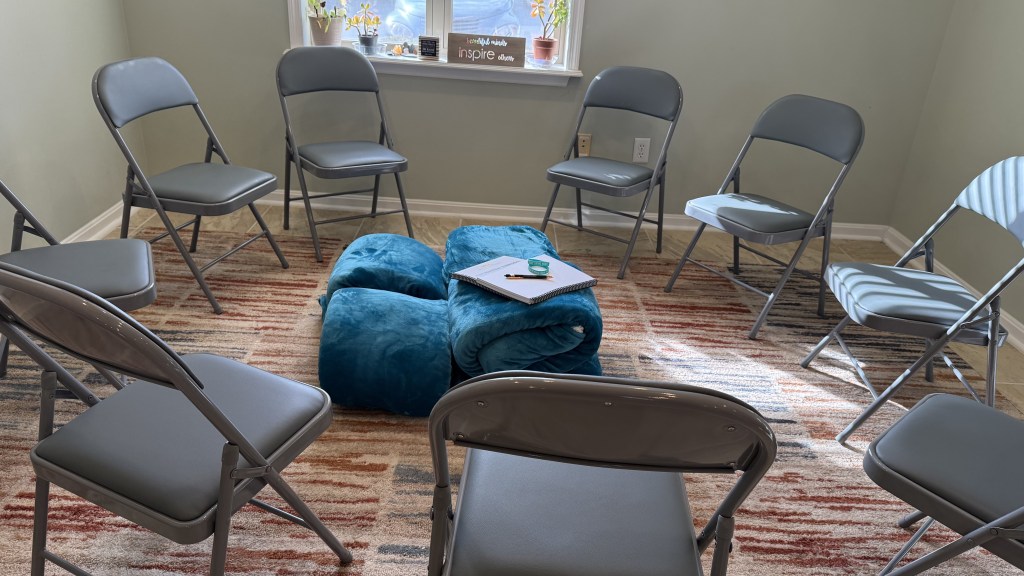
Nervous systems settle together. When fifteen women breathe slowly in the same space, the calm compounds. Bodies take cues from other bodies. A woman who struggles to relax on her own will often drop deeper in a group than she ever would alone, simply because everyone around her is already there.
No one has to tell her story. Good group hypnotherapy is content-free. You are never asked to narrate the worst thing that happened to you, or to explain yourself to strangers. You do the work privately, inside your own mind, in a room where you are safe and unexposed. For women who have spent their lives managing how they are perceived, that combination of depth and privacy is rare.
You leave with witnesses. Say a goal out loud in front of fourteen women who understand what it cost you to say it, and you are far less likely to quietly let it go in January. That is not willpower. That is being known.
What it is not
I want to be straightforward, because this work deserves honesty more than enthusiasm.
Group hypnotherapy is not a cure, and anyone promising that your limiting beliefs will be permanently deleted in one morning is selling something. Neuroplasticity is real, and it takes repetition. A weekend opens a door. What you do in the weeks after walks you through it.
It is also not right for everyone. Some conditions make deep breathwork or group trance unwise, which is why I screen every participant personally. It is not a substitute for therapy or medical care, and if you are in crisis, please do not wait for a workshop. And some work belongs one-to-one. If the root of your self-doubt sits in something tender and specific, I will tell you so.
The invitation
On November 21 and 22, I am opening my doors in Mason to fifteen women for two mornings. I am calling it The Confident Close.
Saturday is release: breathwork, EFT tapping, and group clinical hypnotherapy where you meet that inner critic, understand what it has been protecting you from, and give it a new job. Sunday is alignment: the values that are genuinely yours, then one small win you will finish before December 31, and one real goal for 2027 with its first step written on a January date before you leave.
I am deliberately not asking you to conquer something enormous in five holiday weeks. That would only hand your inner critic more evidence. A small kept promise does far more than an ambitious plan abandoned.
If you have read this far, some part of you recognized that physician. I would like you to find out, in a room full of women, that she was never the only one. Neither are you.
Every step you intentionally take is one step closer to your goal.
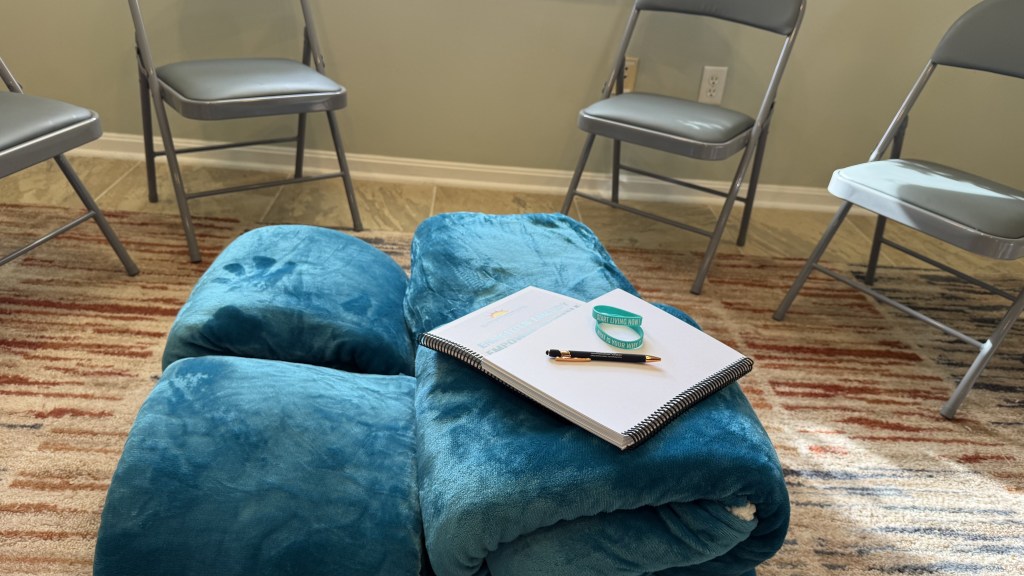
The Confident Close — Saturday and Sunday, November 21 and 22, 2026
9:00 AM to 12:30 PM each morning, with a light lunch together. Mason, Ohio.
Fifteen women only. $297 through November 7, then $397. Participants take home a recording of the hypnosis session. Register at BConfidentNow.com


Leave a Reply